 Quote Request
Compare Multiple Quotes On Your Made To Match Wooden Products


Wood Packs.
Wood packs are timber bought by the parcel rather than the piece: a bundle of sawn boards, beams or squares, usually one species, one section and one grade, priced by the cubic metre. This section lists packs offered through WoodUChoose by mills, importers and merchants, and it works both ways. You can ask for a pack to be quoted, or offer a parcel you want to move.
Nothing on this page is stock we hold ourselves. WoodUChoose is a matching service for solid timber: you tell us the species, sections, grade, moisture content and volume you need, we put that single enquiry in front of suppliers who can cut or select it, and you compare quotes instead of ringing round. Packs are made up to your cutting list in any wood, from oak, ash, beech, sapele and iroko to Scandinavian redwood, whitewood, larch and Douglas fir, in sections no retail shed carries.
That matters most on renovation and heritage restoration work, where a listed building, a period roof or a Victorian joinery repair needs a specific species, cut and grade rather than whatever is on the rack. Browse the packs below, or send us your schedule and we will quote against it.



Wood Packs - Further Reading:
What a pack of timber actually is
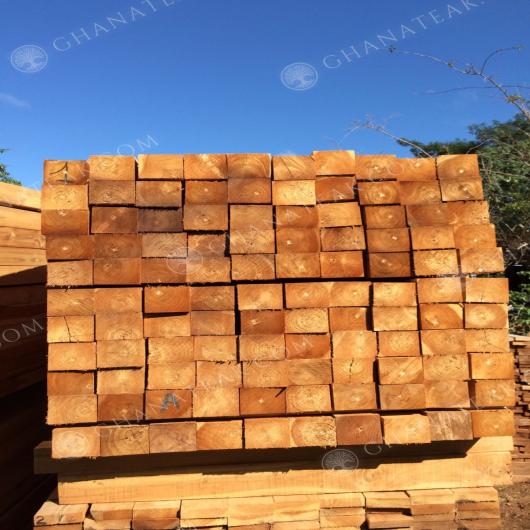
A pack (also called a parcel, bundle or lift) is the unit mills and importers trade in. It is a strapped stack of sawn timber of one species and one nominal section, stickered if it has been dried, and sold as a volume rather than as individual lengths. Pack sizes vary with the section: a pack of 47 x 100 carcassing holds far more pieces than a pack of 100 x 250 beams, but both may sit around the same one to two cubic metres. Hardwood parcels are usually mixed random widths and lengths in a single grade, so you buy a volume and a quality, not a cutting list of exact pieces.
Buying by the pack is cheaper per cubic metre than buying lengths over a trade counter, and it is the only sensible route once a job needs more than a handful of pieces. The trade off is that you specify properly up front, because a pack is cut, graded and strapped for you.
How packs are measured and priced
- By volume (m3). The normal trade unit. To turn that volume into a delivery weight, our sister site WoodUWeigh has a cubic metre weight calculator (opens in a new tab) covering the common species. Volume is calculated on the nominal sawn size, not the finished size, so 47 x 100 is costed as 47 x 100 even after regularising.
- By linear metre (m). Used where a pack is one consistent section and the buyer thinks in run, for example beams, cladding or square edge boards.
- Nominal versus actual. Sawn sizes are nominal and carry a saw tolerance. Planed all round takes roughly 3 to 5 mm off each face, so a nominal 47 x 100 finishes near 44 x 95. Say which one your drawing means.
- Delivery terms. Listings may be quoted ex works, FOB or delivered. FOB prices exclude freight, duty and inland haulage, so always compare on a delivered to site basis.
- Minimum order. Mills price in full packs. Part packs are possible from merchants and importers holding a parcel, usually at a higher rate per cubic metre.
What to send us for an accurate pack quote
The more of this you can give, the tighter the quotes come back. Anything you cannot answer, say so and a supplier will advise.
- Species, or the properties you need if you are open on species (durability class, stability, colour, whether it will be painted or clear finished).
- Sawn sections and lengths, and whether those are nominal or finished sizes.
- Total volume in cubic metres, or the number of pieces per section if you are working from a schedule.
- Grade required, and the grading rules you are working to.
- Moisture content: green, air dried or kiln dried, and the target percentage if the timber is for internal joinery.
- Treatment: untreated, or pressure treated to a use class, and whether it will be cut after treatment.
- Certification, if the project specification calls for FSC or PEFC chain of custody.
- Delivery postcode, access for an artic or a HIAB, and the date the timber is needed on site.
Photographs, a cutting list, a spreadsheet or a marked up drawing are all fine. For a repair or a match, a photograph of the existing timber and a short section profile tell a supplier more than a paragraph of description.
Grades, drying and certification in plain terms
- Structural softwood is strength graded. C16 and C24 are the common UK grades; C24 is stiffer and stronger, and is what most structural calculations for joists and rafters assume. If a structural engineer has specified a grade, it is not interchangeable.
- Joinery softwood is appearance graded. European redwood and whitewood are sold as unsorted, fifths and sixths, or as sawfalling, which is the run of the mill unsorted. Prime and clear grades are cut for visible joinery.
- Hardwood is graded on the clear cuttings you can get out of a board, under NHLA rules for American timber (FAS, FAS 1 Face, Number 1 Common) or the European QF grades. A lower grade is not worse timber, it simply yields shorter clear cuttings, which can be perfectly economic for short components.
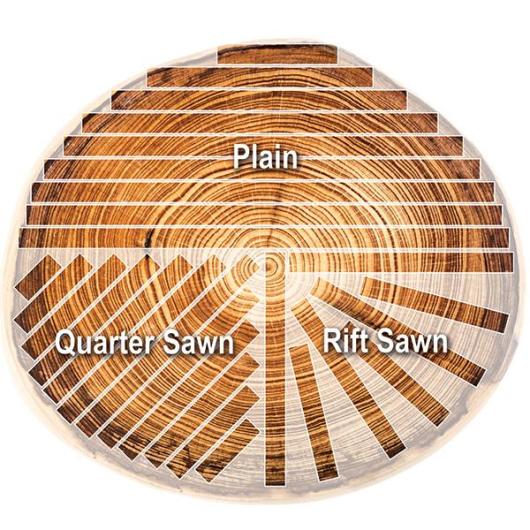
- Sawn method changes how the timber behaves. Quarter sawn and rift sawn boards move far less across the width and show medullary ray figure in oak, which is why they are specified for stair parts, wide joinery and conservation work. Through and through, or waney edge, is the cheapest way to buy wide boards.
- Moisture content is the single biggest cause of failure. Roughly 8 to 12 per cent for internal joinery in a heated building, 12 to 16 per cent for internal structural work, and air dried or green for external framing and green oak. Timber delivered wet into a heated room will shrink and open its joints.
- Certification. FSC and PEFC chain of custody can be supplied where the mill holds it. Ask at enquiry stage, because it has to run through the whole supply chain to be claimable.
Packs for renovation and heritage restoration
Period and listed building work is the case where a pack beats a trade counter outright, because conservation officers specify species, cut and grade rather than a product code. Typical requests we see include air dried or green oak for frame repairs and barn conversions, quarter sawn oak for stair parts and wide panelling, slow grown redwood for Georgian and Victorian sash and joinery repairs, and matched softwood sections for a period roof where the existing timbers are an odd imperial size. Imperial sizes are not a problem: a pack can be cut to 4 x 2, 7 x 2, 9 x 3 or any section you measure off the building. Bring us the sizes you have measured, not the nearest metric equivalent.
Species we can source by the pack
Softwoods include Scandinavian and Baltic redwood (pine), whitewood (spruce), Siberian and European larch, Douglas fir, western red cedar and treated UK carcassing. Hardwoods include European and American white oak, European oak for framing, ash, beech, elm, sycamore, tulipwood, sapele, iroko, idigbo, utile, meranti and accoya. If you need something that is not on that list, ask. We are a solid timber platform only: we do not quote MDF, plywood, OSB, laminate, plastic or composite products, or moulded plaster and polyurethane imitations.
Offering a pack for sale
If you are a mill, importer, merchant or joinery shop sitting on a parcel you want to move, it can be listed here for buyers to find. Useful listings state species, origin, sawn sections, volume, grade, moisture content, sawn method, certification and the delivery terms you are quoting on. See wood trading, wanted and offered for the wider board, or contact us to have a parcel added.
How the quote process works
One enquiry goes to the suppliers able to cut or supply it, and their quotes come back to you to compare on price, lead time and delivery. There is no charge to the buyer and no obligation to proceed. Lead times on a made up pack are typically two to four weeks for softwood and longer for kiln dried hardwood or anything that has to be sawn to order, so allow for drying time if the timber is going into a heated building. Read how it works before you enquire.
Related timber sections
- Sawn timber boards, for individual sawn boards rather than full packs.
- Planed timber, PAR and PSE, where you want the timber machined rather than sawn.
- Standard sawn and planed boards, for common stock sections.
- Timber information and species data (opens in a new tab) on our sister site AnyoneWood, if you are still choosing a species.