
 Quote Request


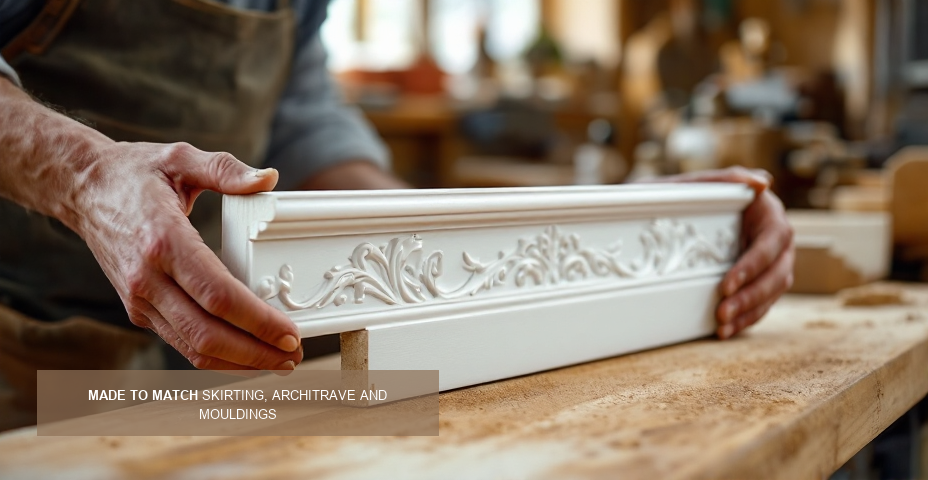
To get existing skirting, architrave or mouldings replicated exactly, you need a physical reference the new timber can be copied from: ideally a clean offcut around 100-150mm long, or a careful tracing and photographs where nothing can be removed. A joinery mill takes that reference, draws the profile to scale, grinds cutters to match and machines fresh lengths to suit. If the pattern you want is a standard stock profile still sold today, a builders' merchant is usually cheaper and faster, so a made-to-match service is best reserved for the profiles you genuinely cannot buy off the shelf.
When a made-to-match service is the right call
Most matching work comes from partial jobs. You are extending a room, repairing damage, opening up a doorway or renovating one part of a period house, and the new joinery has to sit flush against runs that were fitted decades ago. In a Victorian or Edwardian property the original skirting and architrave were often milled to patterns that are no longer stocked, in imperial sizes, from boards that have since shrunk and settled. Dropping a modern stock profile alongside them leaves a visible step and a mismatched shadow line that no amount of caulk will hide.
This is where matching existing skirting and architrave earns its keep. It is also where a bit of honesty saves you money: if you hold your offcut against a merchant's current range and one of their stock profiles fits within a millimetre or so, buy that instead. A matching service is for the profiles that have no off-the-shelf equivalent, not for saving a short trip to the timber yard.
What makes an old profile hard to replace
Skirting and architrave are defined by their profile: the shaped cross-section that gives the moulding its character. Common period shapes include ovolo, ogee, torus and lamb's tongue, often combined and run at heights and depths that modern factories no longer tool up for. A few things make an exact match harder than it first looks:
- Imperial dimensions. Older mouldings were cut to imperial sizes, so a 9 inch skirting will never quite line up with a nominal 225mm modern board.
- Layers of paint. Decades of repainting round off crisp arrises and fill in fine detail, so the profile on the wall can look softer and shallower than the timber underneath actually is.
- Movement and wear. Timber shrinks across its width as it dries over the years, and knocks and sanding wear the face down, so two lengths from the same original run may not even be identical to each other.
- Intricate detail. Deeply undercut or highly ornate patterns can be beyond a standard spindle moulder and may need CNC replication for intricate profiles to reproduce faithfully.
What to measure and photograph before you request a match
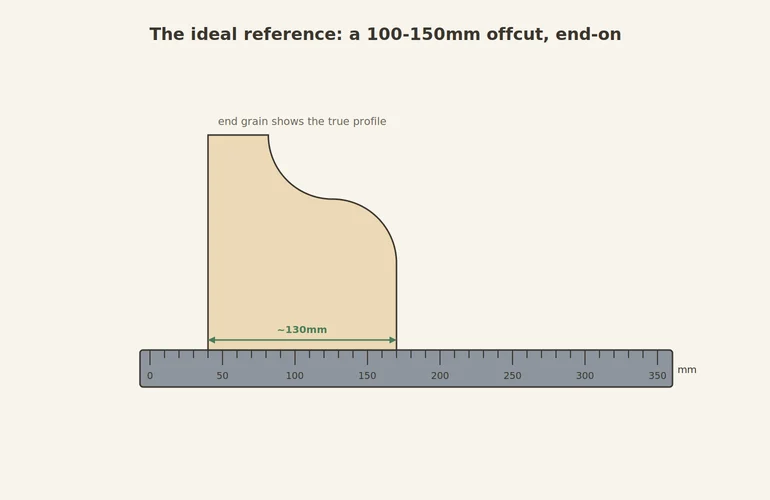
The quality of your match depends almost entirely on the quality of your reference. The single best thing you can provide is a physical sample: a clean offcut around 100-150mm long, cut from an inconspicuous spot such as behind a radiator, inside a cupboard or at a section due to be replaced anyway. A short length lets the mill read the full profile, the true depth and the species in one go. Where you cannot remove a sample, a sharp end-on tracing of the cross-section plus photographs is the next best thing. Use the checklist below.
| What to capture | Why it matters |
| Overall width or height (the face dimension) | Sets the size of blank the moulding is cut from and how it lines up with existing runs |
| Overall depth or thickness | Determines how far the moulding stands off the wall or door frame |
| Profile shape, viewed end-on | The shaped cross-section itself; trace it against a card edge or photograph the cut end square-on |
| Key features (steps, beads, coves, quirks) | The specific details a cutter has to reproduce for the match to read as original |
| A physical offcut (ideal, 100-150mm) | Carries width, depth, profile and species together with no measuring error |
| Photos with a ruler in the frame | Gives the mill scale and proportion when no sample can be removed |
| Bare timber on a hidden section | Helps identify the species where the piece is stained or clear-finished rather than painted |
How timber profile matching works, step by step
Timber profile matching follows a well-worn path from your reference to finished lengths:
- 1. Sample or template. The mill starts from your offcut, tracing or measured drawing. A physical sample needs the least interpretation and gives the most reliable result.
- 2. Profile drawing. The cross-section is drawn out accurately and to scale, allowing for the difference between a worn, painted surface and the crisp shape the cutter should actually produce.
- 3. Cutters ground. Tooling is ground to the drawn profile. For standard shapes that is a set of knives for a spindle moulder; for deep or ornate detail it may mean CNC machining instead.
- 4. Machining. New lengths are run from your chosen species and section, then checked back against the original so the finished moulding sits flush with what is already on the wall.
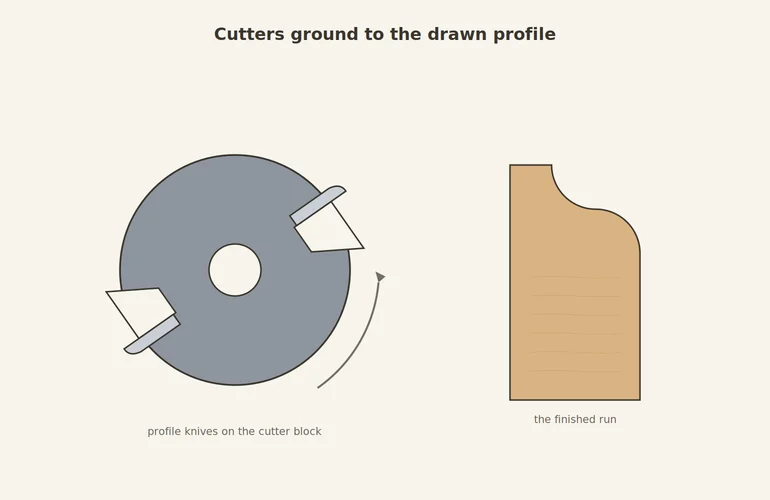
Because bespoke cutters are ground for your specific pattern, it is worth confirming your full quantity up front, including a sensible allowance for cutting and wastage, so every length comes off the same tooling and reads as one continuous run.
Does the species and finish matter?
It depends on how the moulding will be finished. For anything painted, the species matters far less: paint hides the grain, so a stable, paintable section that holds the profile crisply is usually the sensible choice. For work that will be stained, oiled or left clear, the timber itself is on show, and identifying the existing species becomes important so the new grain and colour blend with the old. If you are unsure what the original is, a bare, unfinished section is the best place to judge it, and a wood database can help you narrow it down before you request a match.
The same logic applies to how the timber is prepared. Most mouldings start life as planed timber in a clean, dimensioned section before the profile is run, so agreeing the species and the finished section early keeps the match consistent from the first length to the last.
Matching existing mouldings: common questions
Can you match a moulding without removing a sample? Yes, though the result is only as good as the reference. An accurate end-on tracing plus clear, square-on photographs with a ruler in frame can be enough, but a physical offcut is always more reliable because it carries the depth and species as well as the outline.
Will paint stop you replicating the profile exactly? Thick paint can round off and fill in detail, so the shape on the wall may read softer than the original timber. A good mill allows for this when drawing the profile, which is another reason a bare offcut, where the crisp arrises are still visible, gives the best match.
Do I have to match the species as well as the shape? Only where the timber will be seen. For painted skirting and architrave, the profile and dimensions are what count. For stained or clear-finished work, matching the species matters so the colour and grain sit comfortably alongside the existing runs.
Is it worth matching for a standard modern profile? Usually not. If a current stock profile fits, a merchant is cheaper and quicker. Made-to-match comes into its own for discontinued, imperial or ornate patterns that simply are not sold any more.
Restoring a period property? Read the companion guide: Historic Mouldings - how to identify, replicate and source period timber profiles.
Connect with a specialist for your profile
Matching existing mouldings is precise, made-to-order work, and the right supplier is one set up for bespoke milling rather than boxed stock. WoodUChoose is a matching marketplace: you tell us about your profile, share your sample details and we connect you with vetted UK timber specialists who can replicate your skirting, architrave or mouldings and quote for the job. Start with the made-to-match service to get matched with suppliers and request quotes for your project. There is no obligation, just the right people to talk to about your timber.
 This article was created by a human, written with some help from AI and edited by a human.
 319
319