
 Quote Request


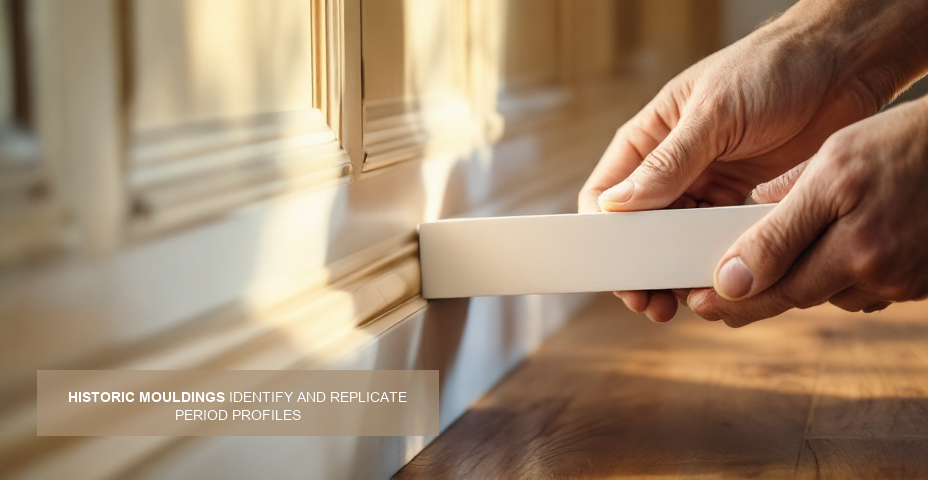
Historic mouldings are the timber profiles - skirtings, architraves, dado and picture rails, cornices, glazing bars and panel mouldings - that give a period property its character, and most are no longer available off the shelf. To repair, extend or reinstate them you first identify the exact profile, then have it reproduced with bespoke tooling or CNC, and match the timber to the original. This guide covers how to recognise period profiles by era, how to capture a section accurately, when a standard moulding will do instead of a bespoke one, and how conservation rules affect the work.
What counts as a historic moulding
A moulding is a shaped length of timber whose cross-section, or profile, is worked into a decorative and functional form. Period joinery uses a fairly small vocabulary of classical elements combined in different ways: the convex quarter-round ovolo, the S-shaped ogee (also called cyma), the deep half-round torus, the concave scotia and cavetto, the small rounded bead or astragal, and the pointed lamb's tongue. Georgian, Victorian and Edwardian joiners drew on the same elements but assembled and proportioned them differently, which is why a trained eye can often date a skirting or architrave from its section alone.
Historic, or period, mouldings become a matching problem when the original profile is no longer stocked. Standard merchant ranges cover the most common Victorian and Georgian-style sections, but anything unusual - a tall bespoke skirting, an ornate bolection surround, a fine astragal glazing bar - usually has to be reproduced to order. That is the point at which replica mouldings and made-to-match work come in.
How to identify a period moulding profile
Identification always starts with the cross-section rather than the length. The most reliable approach is to take a physical record of the profile:
- Press a profile gauge (a contour gauge, with sliding pins or blades) onto the end of the moulding to capture the outline, then trace it onto card.
- Where you can, remove a short offcut from a concealed position - behind a radiator, inside a cupboard, or at the foot of a run - so a supplier has the exact section to work from.
- Photograph the end grain square-on with a steel rule alongside for scale, and record the overall height and projection in millimetres.
- Name the sequence of elements from one edge to the other, for example fillet, ovolo, fillet, cavetto. That description, together with a dimensioned drawing, is what a moulding shop needs.
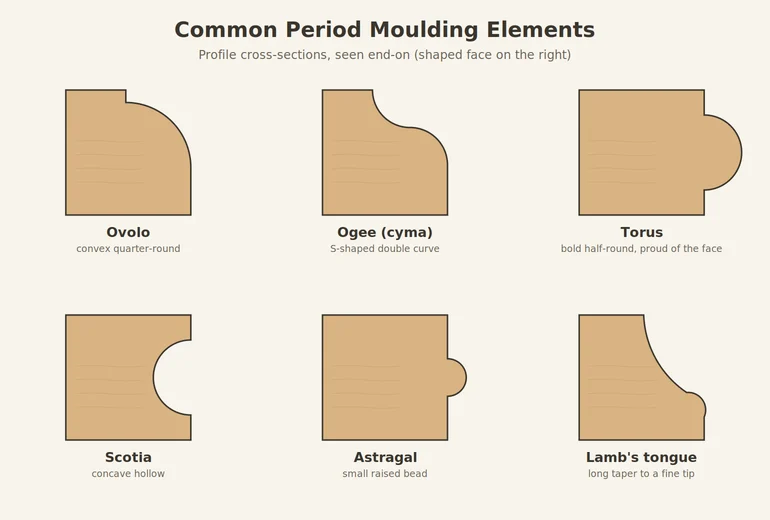
Look, too, at how the moulding was worked. Hand-run mouldings, cut with wooden moulding planes before the middle of the nineteenth century, often show slight variation along their length; machine-run profiles from the Victorian period onward are more uniform. The timber species, and whether the joinery was always painted, are further clues to its age and status.
Period profiles at a glance
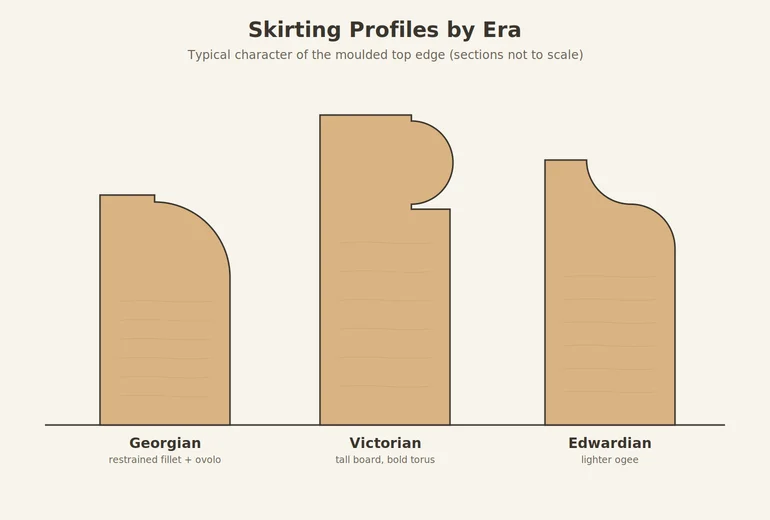
The broad characteristics below are a starting point for dating and matching heritage timber profiles. Treat them as tendencies rather than rules, because mouldings were frequently altered, added to or replaced by later occupants.
| Era | Typical profiles and features | Common species | Character |
| Georgian (c.1714-1837) | Ovolo, ogee and lamb's tongue sections; fielded six-panel doors; slim astragal glazing bars; restrained skirtings; dado and picture rails | Baltic redwood (deal), with some mahogany and oak | Classical, symmetrical and comparatively delicate |
| Victorian (1837-1901) | Tall torus skirtings; heavier ogee architraves; four-panel doors; bolection panel and fire surrounds; machine-run detail | Redwood and pitch pine | Bolder and more elaborate, mass-produced by steam-powered machinery |
| Edwardian (1901-c.1918) | Lighter ovolo and ogee sections; broader, plainer architraves; near-universal picture rails; Arts and Crafts oak detailing | Redwood, with oak in higher-status homes | A return to restraint, with Georgian-revival and Arts and Crafts influences |
The Regency years at the end of the Georgian period favoured fine reeding, a run of parallel convex beads, on architraves and pilasters - a detail worth recognising when it appears, as it is easy to mistake for later work.
Matching existing mouldings, and when replication makes sense
Matching existing mouldings is partly an economic decision. If a stock profile from a timber merchant genuinely matches your section, that is almost always the cheaper and faster route, and there is no need to commission anything bespoke. It is worth taking your gauge or offcut to a good merchant first to check the standard ranges.
Bespoke replica mouldings earn their cost when the profile is non-standard, when a damaged length has to match an existing run exactly, or when conservation requires a like-for-like reproduction. Extending a room, making good after structural work, or replacing a few damaged lengths in an otherwise intact scheme all call for an exact match that a near-miss standard profile would spoil. WoodUChoose's made-to-match service exists for precisely this: reproducing heritage timber profiles that are no longer stocked.
Replicating a profile: from gauge to cutter
Replication turns your recorded profile into a cutting tool. For most run mouldings, a supplier grinds a bespoke profile cutter, or knife, to the exact section and runs the timber through a spindle moulder or four-sided moulder. For intricate or three-dimensional work, CNC machining reproduces detail that would be slow to cut by hand, while genuine hand-carving is reserved for enrichments such as egg-and-dart or dentil cornices.
The quality of the match depends almost entirely on the quality of the recorded section, which is why a physical offcut beats a photograph. WoodUChoose's bespoke CNC moulding tool is built around replicating intricate profiles from a supplied sample, and connects the work to specialist workshops through the wider bespoke joinery service.
Choosing the right timber
Match the timber to the original wherever the moulding will be seen. For painted period joinery - the great majority of skirtings, architraves and sash windows - redwood (Scots pine, historically imported as Baltic deal) is the honest, traditional choice and takes paint well. For exposed or stained work, oak is usual, both to match surviving Georgian and Arts and Crafts joinery and for its durability. Pitch pine turns up in Victorian floors and church joinery, and mahogany in high-status doors and handrails.
If you are not sure what you are matching, compare grain, weight and colour against reference samples in the WoodUChoose wood database before you specify, so the replica reads correctly once it is fitted and finished.
Listed buildings and conservation
If your property is listed or sits within a conservation area, altering or replacing historic joinery may need listed building consent, and it is sensible to speak to your local planning authority or conservation officer before removing any original fabric. Good conservation practice favours repair over replacement: splicing or scarfing new timber into sound original material keeps more of the historic moulding than swapping a whole length. Where replacement is unavoidable, a like-for-like replica in matching timber is normally what a conservation officer will expect.
Common questions about historic mouldings
Can I match a moulding without removing a section?
Yes. A contour gauge pressed onto the profile, or a square-on photograph with a scale rule, will capture the shape well enough for most work. A short offcut taken from a concealed spot is still the gold standard when the match has to be exact.
Do I need consent to replace period mouldings?
Possibly. If the building is listed or in a conservation area, changes to historic joinery can require listed building consent, so check with your local planning authority first. Like-for-like repair is usually the preferred approach.
Is bespoke replication worth it when a standard profile is close?
If a stock profile genuinely matches, a merchant is cheaper and quicker and you should use it. Bespoke replication is for profiles that are non-standard, or that must match an existing run exactly, where a near-miss would be obvious once fitted.
What timber should replica mouldings be made from?
For painted work, redwood or pine as historically used; for exposed or stained work, oak, or whatever species matches the original. Checking the section against the wood database helps you specify with confidence.
Need a specific profile copied? See the companion guide: Made to Match - getting existing skirting, architrave and mouldings replicated exactly.
Get your profile matched to a specialist supplier
WoodUChoose does not sell timber. It connects you with vetted UK suppliers who can grind bespoke tooling and reproduce your profile in the right species, so you deal directly with a specialist joinery workshop rather than settling for the nearest stock section. If you have a profile to match, capture the section, note the dimensions and request quotes through the made-to-match service - you will be connected with suppliers set up for heritage timber profiles and bespoke moulding runs.
 This article was created by a human, written with some help from AI and edited by a human.
 511
511