 Quote Request
Compare Multiple Quotes On Your Made To Match Wooden Products


Made to Match - Mouldings.
Timber mouldings made to match - every length made to order in the profile and the wood you specify. Tell us the section you need and UK timber mills and joinery shops quote against it, whether that is one length to match a period property or a full set of wood mouldings for a renovation.
We match moulding profiles of every kind: ogee, torus, ovolo, scotia, bullnose, lambs tongue, chamfered, quadrant, staff bead, and reeded or fluted work, along with one-off sections that have no standard name. Species run from oak mouldings and other hardwood mouldings to pine and redwood softwood mouldings, so paint-grade and clear-finished work come from the same enquiry.
This is also the route for period mouldings - Victorian, Edwardian, Georgian, Regency and Arts and Crafts - where the original cutter is long gone and nothing on a merchant's shelf lines up. Nothing here is off-the-shelf stock. Pick the closest profile shape on this page, or use the Made to Match wizard, and your one enquiry goes out to several suppliers so you can compare quotes side by side.
Made to Match Existing Made to Match - Mouldings.
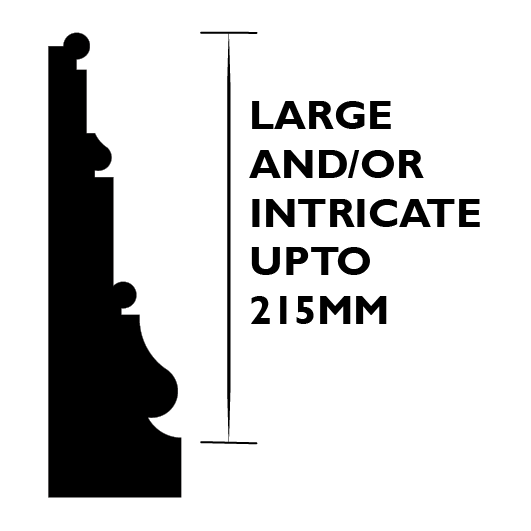
If you are looking to match existing Made to Match - Mouldings, please select the profile that best / closest matches your product from the following options. Alternatively, we also have a range of pre-designed Made to Match - Mouldings mouldings to choose from by using the filters further down this page.




|
Get a price: choose the closest profile above for an instant guide price, then compare quotes from UK suppliers.
Made to Match - Mouldings - Further Reading:
How to get an existing timber moulding matched
A supplier can only copy a profile they can see. There are three ways to show them, in order of accuracy:
- Send a sample. A 150mm to 300mm offcut is best. Take it from inside a cupboard, behind a radiator or above a door, where a short piece will not be missed. The mill can then copy the section exactly and grind a cutter to it.
- Photograph the end grain. Find or cut a clean square end, stand a steel rule alongside it, and shoot straight on. A photo of the face taken at an angle hides the depth of the section and cannot be worked from.
- Send a drawing or template. Press a profile gauge onto the moulding, trace round it onto card, and scan or photograph the tracing flat and at full size. Mark which edge is the top.
What to measure before you enquire
- Height and thickness of the section in millimetres, taken at the widest and deepest points.
- Total length required, plus roughly ten per cent for mitres, cutting and waste. Say the longest single length you need: stairs, landings and long hallways often need over 3 metres, and that changes which suppliers can help.
- Species and finish. Say whether the moulding will be painted or clear finished. Painted work is usually run in a stable softwood or a paint-grade hardwood; clear-finished work needs the grain and colour matched to the joinery already in the room.
- Where it is going - internal, external, or an older solid wall that may hold damp - so the species and moisture-content advice is right.
Matching mouldings in a period or listed building
Victorian, Edwardian, Georgian, Regency and Arts and Crafts profiles were run on cutters that no longer exist, and the detail varied by region and by builder, so a catalogue lookalike rarely sits flush against what is already on the wall. Copying the section from the room itself is the only reliable route. In a listed building or a conservation area, speak to your local authority conservation officer before work starts: like-for-like replacement in the same species and section is normally what they expect, and having the original profile copied supports that case. Where only a few metres are needed, ask each supplier to price the cutter charge separately, because that cost is much the same whether you order 5 metres or 50.
How the quote process works
Use the system on this page for an instant online estimate, then send one enquiry out to UK timber suppliers, mills and joinery manufacturers and compare what comes back. We are not a stockist and we hold no stock: every timber moulding is cut to order, so lead time and any cutter charge are worth comparing alongside the price per metre. The matching service covers skirting, architrave, dado and picture rail, coving and cornice, beading, panel mould, handrail and window sections, in any profile and any wood.
Related: Period Wood Mouldings, Bespoke Mouldings, Intricate Mouldings (CNC) and How it Works.
Return to Made to Match - Mouldings Introduction and Products »